The foundation of the best parking system is built on a seamless blend of speed, security, and efficiency, and we believe that Radio Frequency Identification (RFID) technology is the key to achieving this. For businesses, residential complexes, and large corporate campuses, the daily challenge of managing vehicle access can lead to significant bottlenecks, frustration, and security vulnerabilities. We understand that procurement managers and project leaders are constantly seeking solutions that not only solve these problems but also offer a superior return on investment.
The Core Pillars of a Modern Parking System
A truly modern and best parking system must address three critical areas: throughput, security, and operational cost. Traditional methods often force a compromise between these factors.
Why Traditional Systems Fall Short
Many existing parking solutions rely on outdated technology that introduces friction and inefficiency:
- Barrier Gates and Tickets: These systems are slow, require vehicles to stop completely, and are prone to mechanical failure, leading to long queues during peak hours.
- Keypads and Access Cards: While offering better security than simple tickets, these require the driver to physically roll down a window, find the card, and swipe or enter a code, which is inconvenient, especially in bad weather.
- Manual Security Checks: Relying on human guards to verify credentials is costly, inconsistent, and introduces human error into the security process.

RFID: The Technology Driving Seamless Access
RFID technology offers a robust, hands-free solution that eliminates the friction points of older systems. Specifically, Ultra-High Frequency (UHF) RFID is the standard for vehicle access control due to its long read range and high-speed processing capabilities.
How UHF RFID Tags Work for Vehicles
UHF RFID tags, often applied as windshield stickers or license plate labels, contain a microchip and antenna. When a vehicle approaches the entry point, a fixed reader sends out a radio signal. The tag, powered by this signal, instantly transmits its unique identification data back to the reader. This process happens in milliseconds, allowing for near-instantaneous gate opening without the vehicle needing to stop.
Key Components of an RFID Vehicle Access System
| Component | Function | RFIDLabel Product Focus |
| UHF RFID Tag | Stores unique vehicle ID; passive, long-range. | Customizable RFID Labels and Stickers |
| Fixed Reader | Emits radio waves and captures tag data. | Compatible with all major reader brands |
| Antenna | Directs the radio frequency field. | Optimized for long-range reading |
| System Software | Manages the database of authorized IDs and controls the gate. | Seamless integration with existing systems |

Enhanced Security: Beyond the Simple Swipe
The best parking system is also the most secure. Modern RFID tags are far more than simple identifiers; they incorporate advanced security features to prevent cloning and unauthorized access.
Cryptographic Authentication: The Anti-Cloning Shield
High-security RFID solutions utilize cryptographic authentication. This means the tag and the reader engage in a secure, two-step handshake process. Without the correct cryptographic key, the tag’s data cannot be read or validated. This makes it virtually impossible for malicious actors to clone a tag or intercept the communication for fraudulent entry.
Case Study: Boosting Throughput at a Major University Campus
A compelling example of RFID’s impact is the implementation of an Automated Vehicle Identification (AVI) system at the University of Georgia (UGA), a campus with over 34,000 students and 10,000 staff. The university faced significant congestion and delays at parking deck entrances and exits. By integrating RFID-based AVI technology, which uses window sticker tags, the university was able to dramatically speed up the process of entering and exiting gates. The system reduced the typical transaction time for a customer from 15 to 4 seconds, leading to an improvement in throughput of more than 77% at peak hours. This not only enhanced convenience and customer satisfaction but also allowed the parking services department to deliver a consistently high level of service.

Why RFIDLabel is Your Partner for the Best Parking System
We specialize in manufacturing the high-quality, customizable RFID tags and labels that form the backbone of any best parking system. Our products are designed for durability, long-range performance, and seamless integration. Whether you require RFID labels for a corporate fleet or durable RFID cards for an access control system, we offer flexible minimum order quantities and a commitment to quality that meets the rigorous demands of North American and European markets.
Customization and Quality for Your Project
We understand that every project is unique. Our factory offers extensive customization options for your RFID tags, including:
- Custom Logos and Branding: Enhance your corporate identity.
- Eco-Friendly Materials: Options for sustainable solutions.
- Optimized Performance: Tags tuned for specific reader frequencies and environments.

Conclusion
The pursuit of the best parking system inevitably leads to RFID technology. By replacing outdated, slow, and insecure methods with high-speed, cryptographically secure RFID access control, organizations can dramatically improve traffic flow, enhance security, and reduce operational costs. We encourage you to explore our range of customizable RFID cards, tags, and labels at RFIDLabel.com to find the perfect components for your next project, or contact us today to discuss a custom solution tailored to your exact needs.
FAQs
What is the typical read range for UHF RFID vehicle access tags?
The read range for UHF RFID in vehicle access control can vary based on the reader, antenna, and tag type, but it commonly ranges from 5 to 10 meters (16 to 33 feet), allowing for true “drive-through” access without stopping.
Can the same RFID tag be used for both parking access and other applications, such as time and attendance?
Yes, a single, multi-functional RFID tag or card can be encoded to work with multiple systems, such as parking access, building entry, and time and attendance tracking, streamlining credentials management for users.
Recommended Product
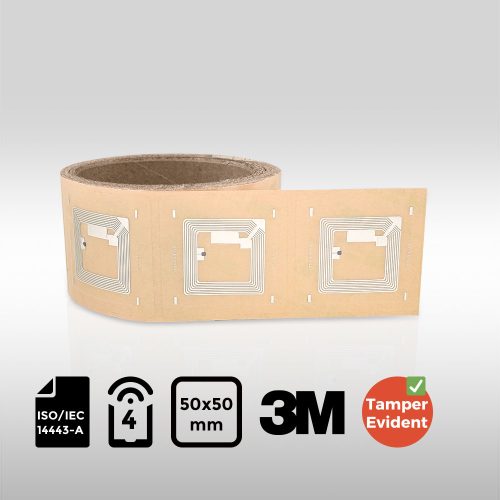
Single-Layer Tear-Resistant Windshield NFC Label NXP® MIFARE® DESFire® EV3 2K | 50×50mm

The NXP® MIFARE® DESFire® EV3 2K Single-Layer Tear-Resistant Windshield NFC Label is a premium, high-security identification tag designed for reliable vehicle authentication and smart access applications. Built with the powerful DESFire® EV3 2K chip, it offers advanced cryptographic security, fast transaction speed, and exceptional data integrity—making it ideal for parking management, gated community access, fleet control, and tolling solutions. Its thin, lightweight structure ensures excellent RF performance when applied to automotive glass,providing stable NFC communication and long service life.
Engineered with a transparent PET layer, precision inlay, and strong 3M adhesive, this windshield label maintains a clean, discreet appearance while ensuring firm attachment. The tear-resistant die-cut (knife-cut anti-tamper) structure provides a clear indication of attempted removal, enhancing security and preventing label reuse. With its combination of durability, aesthetics, and robust security features, this windshield NFC label is the perfect choice for modern vehicle identification and access control systems.
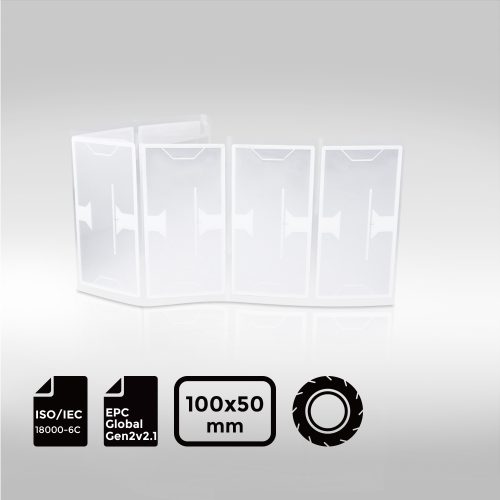
NXP UCODE® 9 PET RFID UHF Tire Label | 100×50mm
The 100×50 mm NXP UCODE® 9 RFID UHF Tire Label is a high-performance RFID label for tire tracking and management. Built with NXP UCODE® 9 chip, this UHF RFID label provides enhanced read range, fast encoding speeds, and excellent reliability in challenging environments.
This RFID tire label is engineered to withstand pressure and exposure to rubber products, making it an ideal solution for tire manufacturing, inventory management, and life-cycle tracking. The 100*50 mm size balances readability and discreet integration into the tire structure. It is designed for embedding or surface application on rubber materials. It is fully compliant with ISO 18000-6C and EPC Class1 Gen2 standards. Each Label has a unique TID and cannot be changed. It is ideal for tire manufacturers, distributors, and fleet management companies seeking an efficient and automated tracking solution.
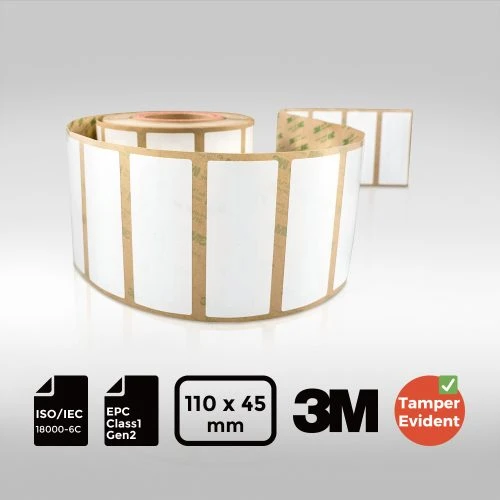
UHF RFID Windshield Label with Security Cuts 110x45mm | Alien Higgs® 9
The Alien Higgs® 9 RFID windshield label is designed to enhance your vehicle tracking capabilities. Embedded with the advanced Alien Higgs® 9 chip, the label compliant to GS1 Class 1 Gen 2 and ISO/IEC 18000-6C to ensure high-accuracy reading. Equipped with a strong and durable 3M467 adhesive, it provides a strong adhesion, perfectly combining security and efficient tracking. In addition, the label adopts a tamper-evident security cuts design, which cannot be used once removed to protect your information security.