RFID is widely used for tracking cartons, apparel, electronics, pallets, and returnable assets. But once liquid is involved, the project becomes more difficult.
A standard RFID label that works well on a dry carton may perform poorly on a bottle of water, a cosmetic container, a vial of medicine, or a chemical drum. The problem is not only the label. Liquids, container materials, label position, bottle curvature, reader antenna setup, and packaging density can all change RFID performance.
That is why on-liquid RFID labels exist.
On-liquid RFID labels are designed for products where ordinary RFID labels may lose read range or become unstable because of nearby liquid. They are commonly used on beverages, pharmaceuticals, cosmetics, chemicals, laboratory samples, and other liquid-filled containers.
This guide explains why liquids affect RFID signals, how on-liquid RFID labels help, and what buyers should test before mass production.

What Are On-Liquid RFID Labels?
On-liquid RFID labels are RFID labels designed to work more reliably when attached to or placed near liquid-filled containers.
They are not simply “waterproof stickers.” A waterproof label may resist moisture on the surface, but that does not mean it can maintain RFID performance near liquid. On-liquid RFID labels are designed with antenna structures, materials, and spacing that help reduce the negative effect of liquid on the tag’s performance.
They are often used on:
- Glass bottles
- Plastic bottles
- Cosmetic bottles
- Pharmaceutical vials
- Chemical containers
- Laboratory tubes
- Liquid pouches
- Drums, cans, and kegs
In many projects, on-liquid RFID labels are used when the customer needs better inventory visibility, batch traceability, anti-counterfeiting, warehouse automation, or item-level tracking for liquid products.
Why Do Liquids Interfere with RFID Signals?
Liquid products create a difficult RFID environment because they can absorb, weaken, or change radio frequency energy.
This is especially noticeable with UHF RFID. UHF RFID is often chosen for supply chain and warehouse applications because it supports longer read ranges and fast multi-tag reading. However, UHF signals are also sensitive to the surrounding material. When a standard UHF RFID label is placed directly on a liquid-filled container, the tag may no longer behave the same way it did during normal testing.
There are three main reasons.
1. Liquids Can Absorb RF Energy
Many liquids, especially water-based liquids, absorb part of the RF energy from the reader. When this happens, less energy reaches the RFID chip.
Passive RFID tags do not have their own battery. They rely on the reader’s signal to power the chip and send data back. If the liquid weakens that signal, the tag may respond from a shorter distance or fail to respond consistently.
This is why a label may read well on an empty bottle but perform worse when the bottle is filled.
2. Liquids Can Detune the RFID Antenna
An RFID antenna is designed to work within a specific frequency range. Its performance depends on the surrounding environment.
When a label is placed near liquid, the liquid changes the electromagnetic environment around the antenna. This can shift the antenna away from its ideal tuning point. In RFID projects, this is often described as antenna detuning.
When detuning occurs, the tag may still work, but not as efficiently. The result may be:
- Shorter read range
- Unstable reading
- Missed reads during bulk scanning
- Strong performance from one angle but weak performance from another
- Large difference between empty-bottle and full-bottle testing
A common mistake is assuming that a label only needs a strong chip. Chip sensitivity matters, but antenna design and application surface matter just as much.
3. Liquids Can Block Signals in Dense Packaging
A single bottle may be readable in a simple desktop test. But the real challenge often appears when products are packed closely together.
For example, when bottles are packed in a carton or stacked on a pallet, the reader may need to scan through several layers of liquid. If the tags are facing inward or blocked by other bottles, the read rate can drop.
This is why RFID testing should not stop at one bottle. A serious test should include the actual packaging format: single item, inner box, carton, shelf, case, or pallet.

Different Liquids Affect RFID in Different Ways
Not all liquids behave the same. The liquid type, water content, conductivity, viscosity, temperature, and container structure can all affect RFID performance.
| Liquid Type | Typical RFID Impact | Notes |
| Water and water-based drinks | Often strong impact | Water absorbs RF energy and may reduce UHF read range |
| Juice, syrup, liquid medicine | Medium to strong impact | Performance depends on water content, sugar, additives, and packaging |
| Saline or electrolyte solutions | Often stronger impact | Conductive liquids can be more difficult for RFID |
| Alcohol-based products | Variable impact | Depends on concentration, bottle type, and label placement |
| Oil-based liquids | Usually less impact than water | Still requires testing because packaging and label position matter |
| Cosmetics and lotions | Variable impact | Creams, gels, and emulsions may behave differently |
| Chemical liquids | Highly variable | Conductivity, safety requirements, and container material must be checked |
This is why suppliers should avoid giving one fixed read range for every liquid product. A realistic RFID label recommendation should be based on the actual liquid, container, label size, and reading environment.
Container Material Also Matters
The liquid itself is only one part of the problem. The container can also affect RFID performance.
| Container Type | What to Watch For |
| Plastic bottle | Usually easier than glass or metal, but liquid content still matters |
| Glass bottle | Common for beverages, cosmetics, and pharmaceuticals; thickness and curvature may affect placement |
| Metal can or metal cap | Metal can reflect or block RF signals; special RFID label structures may be needed |
| Aluminum foil seal | Can interfere if the label is too close to the sealed area |
| Small vial or tube | Small diameter increases bending stress and limits antenna size |
| Chemical drum | Larger surface area helps placement, but chemical resistance and safety environment must be considered |
In many bottle projects, the best result comes from balancing three things: the right label, the right position, and the right reader setup.
Standard RFID Labels vs On-Liquid RFID Labels
A standard RFID label may work on liquid products in some situations, especially if the label is not too close to the liquid or the reading distance is short. But for stable scanning in real operations, an on-liquid RFID label is often a safer choice.
| Item | Standard RFID Label | On-Liquid RFID Label |
| Main design target | Cartons, dry packaging, general products | Bottles, vials, liquid containers, moist environments |
| Performance near liquid | May lose read range or become unstable | Designed to reduce liquid interference |
| Antenna design | General-purpose antenna | Antenna structure optimized for liquid-facing applications |
| Label structure | Usually thinner and simpler | May use special materials, spacing, or structure |
| Best use case | Dry goods, apparel, packaging, non-liquid assets | Beverages, cosmetics, pharmaceuticals, chemicals |
| Testing requirement | Recommended | Strongly recommended before mass production |
The key point is this: on-liquid RFID labels do not make physics disappear. They reduce the problem, but the final performance still depends on the product and environment.
How On-Liquid RFID Labels Improve Performance
On-liquid RFID labels are designed to make RFID reading more stable around liquid-filled containers. Different label designs may use different approaches, but the goal is usually the same: keep the antenna working efficiently despite the liquid nearby.
Specialized Antenna Design
The antenna layout is designed to work better when placed near liquid or on curved containers. A suitable antenna can help reduce detuning and improve the tag’s ability to receive and return RF energy.
This is especially important for UHF RFID applications where the customer needs longer read range or bulk reading.
Material and Structural Support
Some on-liquid labels use PET, foam, or other layered materials to improve durability and create a more suitable distance between the RFID antenna and the liquid surface.
This spacing may seem small, but in RFID performance it can make a meaningful difference.
Better Stability on Curved Surfaces
Many liquid products are packed in bottles, tubes, vials, or cans. These are rarely flat surfaces.
A label used on a curved bottle must be flexible enough to stay attached but stable enough to avoid excessive antenna deformation. If the label is too long, too stiff, or poorly placed, it may lift at the edges or bend the antenna too much.
A good on-liquid RFID label should be selected with the bottle diameter and application method in mind.

Does Bottle Curvature Affect RFID Performance?
Yes. Bottle curvature can affect both adhesion and RFID performance.
When a label is applied to a curved surface, the RFID antenna bends with the container. A small amount of bending is normal, but strong bending may change the antenna geometry and affect read range.
Curvature can also create physical problems:
- Label edge lifting
- Wrinkles during application
- Uneven contact with the surface
- Poor adhesion after cold storage or transport
- Inconsistent tag orientation during reading
For small bottles or narrow tubes, it is usually better to test a smaller label or a label specifically designed for curved surfaces. For large bottles or drums, there may be more flexibility in label size and placement.
Best Placement Practices for RFID Labels on Liquid Containers
Placement is often the difference between a successful RFID project and a frustrating one.
Even a good on-liquid RFID label may perform poorly if it is placed in the wrong position.
1. Test the Label on the Actual Filled Product
Do not test only on an empty bottle. Empty and filled containers can perform very differently.
Test at least three conditions:
- Empty container
- Half-filled container
- Fully filled container
If the product is usually scanned after filling, packaging, or cold storage, test it in that condition.
2. Avoid Metal Caps, Foil Seals, and Metalized Areas
If the bottle has a metal cap, foil seal, metal coating, or metallic decorative layer, avoid placing the RFID label too close to those areas.
Liquid already creates signal challenges. Adding metal nearby can make the tag harder to read.
3. Consider the Air Gap Inside the Bottle
Some products are not filled completely to the top. If there is an air gap, testing a label position near that area may improve performance.
This does not work for every product, but it is worth testing when read range is unstable.
4. Keep the Tag Facing the Reader When Possible
RFID does not require line-of-sight like a barcode, but tag orientation still matters.
For conveyor systems, shelves, portals, or pallet reading, try to place the tag where it is more likely to face the reader antenna.
If bottles are packed in cartons, the tag should face outward whenever possible.
5. Check Automatic Labeling Requirements
A label that reads well by hand may not be suitable for automatic application.
Before confirming the label design, check:
- Roll direction
- Label gap
- Core size
- Label stiffness
- Bottle curvature
- Application speed
- Required print area
- Whether the RFID inlay position conflicts with printed artwork
This step is often overlooked, but it matters for real production.

How to Test On-Liquid RFID Labels Before Mass Production
For liquid products, testing should be part of the selection process, not an afterthought.
A practical test should include the product, packaging, and reading method that will be used in real operation.
| Test Item | What to Check |
| Single bottle test | Basic read range and best label position |
| Empty vs full container | Difference caused by liquid content |
| Different label positions | Front, back, side, upper area, lower area |
| Different orientations | Vertical, horizontal, tilted, curved placement |
| Reader type | Handheld reader, fixed reader, tunnel, portal, conveyor |
| Carton test | Read rate when bottles are packed together |
| Pallet test | Performance with dense liquid products |
| Environmental test | Cold storage, humidity, condensation, transport friction |
| Application test | Adhesion, edge lifting, label wrinkling, roll feeding |
| Data test | EPC encoding, user memory, duplicate reads, missed reads |
When recording results, do not only write down the maximum read distance. Maximum distance can be misleading.
A better test records:
- Stable read distance
- Read rate
- Missed read count
- Reader power setting
- Tag orientation
- RSSI or signal strength, if available
- Packaging condition
- Failure points
This gives the buyer and supplier a much clearer picture of whether the label is suitable for mass production.
For more practical testing methods, including filled bottle tests, carton tests, pallet tests, and reader setup checks, you can also read:
→ RFID Labels for Liquid Products Testing Guide
Common Reasons RFID Labels Fail on Liquid Products
When RFID labels fail on liquid containers, the cause is often not just one thing. It is usually a combination of label choice, placement, material, and system setup.
| Problem | Possible Cause | Practical Solution |
| Short read range | Liquid absorption or antenna detuning | Use on-liquid RFID label and test different positions |
| Reads well when empty but not when full | Liquid content changes RF environment | Test only with actual filled products |
| Some bottles read, others do not | Inconsistent tag position or orientation | Standardize label placement and application process |
| Label peels off | Moisture, cold storage, curved surface, wrong adhesive | Choose suitable face material and adhesive |
| Good single-item read, poor carton read | Dense liquid blocks signals | Place tags outward and test carton/pallet layout |
| Poor performance near cap | Metal cap or foil seal interference | Move label away from metal areas |
| Wrinkled label on small bottle | Label too large or too stiff | Use smaller or more flexible label design |
This type of troubleshooting helps avoid the common mistake of blaming the RFID chip alone. In liquid applications, the whole structure must be considered.
Applications of On-Liquid RFID Labels
On-liquid RFID labels are used in industries where liquid products need better visibility, faster inventory control, or stronger traceability.
1. Beverage Industry
Beverage products often involve large volumes, many SKUs, and fast movement through warehouses and distribution centers.
On-liquid RFID labels can help track bottled drinks, wine, spirits, kegs, and other liquid products. They can support inventory counting, batch tracking, anti-counterfeiting, and shipment verification.
For premium beverages, RFID can also support product authentication and customer interaction when combined with NFC or a digital product platform.
2. Pharmaceutical Industry
Liquid medicines, vaccines, reagents, and laboratory samples often require strict traceability.
RFID labels can help identify individual containers, manage batches, reduce manual scanning, and support recall or verification workflows. For pharmaceutical products, label durability, data accuracy, and process control are especially important.
If the product is stored in cold chain conditions, the label should also be tested under the actual temperature and humidity conditions.
3. Cosmetics and Personal Care
Cosmetics and personal care products often use glass or plastic bottles with curved surfaces. Products such as perfume, lotion, shampoo, serum, and skincare liquid may require both attractive packaging and reliable tracking.
On-liquid RFID labels can support warehouse management, brand protection, product authentication, and retail inventory visibility. Label size, print area, and placement should be considered carefully so the RFID label does not interfere with packaging design.
4. Chemical Industry
Chemical products may involve strict inventory control, safety management, and regulatory documentation.
RFID can help track chemical containers, reduce manual checking, and improve visibility in warehouses or production areas. For chemicals, label material, adhesive, chemical resistance, and safety environment should be reviewed before selection.

How to Choose the Right On-Liquid RFID Label
Choosing an on-liquid RFID label is not only about chip model or label size. The correct choice depends on the application.
Before asking for a quotation, prepare the following information:
| Information Needed | Why It Matters |
| Liquid type | Different liquids affect RFID differently |
| Container material | Glass, plastic, metal, and foil structures behave differently |
| Container size and shape | Curvature affects label size, adhesion, and antenna bending |
| Fill level | Full, half-filled, and empty containers may perform differently |
| Read distance requirement | Helps decide label type and reader setup |
| Reading method | Handheld, fixed reader, conveyor, tunnel, or portal |
| Packaging format | Single item, carton, shelf, case, or pallet |
| Storage environment | Humidity, cold chain, condensation, heat, chemicals |
| Printing and encoding needs | Affects production process and label structure |
| Application method | Manual labeling or automatic labeling |
A supplier can give a much better recommendation when these details are clear.
UHF, HF, or NFC: Which Is Better for Liquid Products?
The best frequency depends on the application.
| Technology | Typical Use | Notes for Liquid Products |
| UHF RFID | Warehouse, logistics, bulk scanning, long-range reading | Sensitive to liquid, but on-liquid UHF labels can improve performance |
| HF RFID | Shorter-range identification and controlled scanning | Often used in library, access, and item identification applications |
| NFC | Smartphone interaction, authentication, consumer engagement | Useful for smart packaging, but not designed for long-range bulk inventory |
For warehouse inventory and supply chain tracking, UHF RFID is usually preferred because it supports longer read range and multi-tag reading. For consumer interaction or product authentication through smartphones, NFC may be more suitable.
Some projects may even use dual-frequency labels when both warehouse scanning and consumer interaction are required.
Before You Start: Questions Buyers Should Ask
Before choosing an RFID label for liquid products, ask these questions:
- Will the label be applied to an empty or filled container?
- What type of liquid is inside the container?
- Is the container glass, plastic, metal, or a mixed material?
- Does the container have a metal cap or foil seal?
- What read distance is actually required?
- Will the label be read one by one, in cartons, or on pallets?
- Is the label applied manually or by machine?
- Will the product be stored in cold, wet, or chemical environments?
- Does the label need printing, encoding, or serialization?
- Can samples be tested before mass production?
These questions make the project easier to evaluate and reduce the risk of choosing the wrong label.

Summary
On-liquid RFID labels are designed to improve RFID performance on liquid-filled containers, but the final result still depends on the liquid type, container material, bottle curvature, label placement, and reader setup.
Before mass production, the safest approach is to test samples on the actual filled product and real packaging format. This helps confirm stable read range, reduce missed reads, and choose the right RFID label for the application.
If you want to go one step further and learn how to test RFID labels on real liquid products before mass production, read our practical testing guide:
→ RFID Labels for Liquid Products Testing Guide
If you are not sure which label is suitable for your application, share your product type, liquid type, container size, expected label position, read range requirement, and reading workflow with our team. We can help recommend suitable on-liquid RFID labels and provide samples for practical testing.
→ Explore On-Liquid RFID Label options
For more RFID industry knowledge and product information, please visit rfidlabel.com.
FAQs
1. Why do liquids reduce RFID read range?
Liquids can absorb RF energy and change the tuning of the RFID antenna. This reduces the energy available to the chip and may cause shorter read range, unstable reads, or missed scans.
2. Can RFID tags read through water?
RFID performance through water is difficult, especially for UHF RFID. Water can absorb radio frequency energy, so the result depends on the tag design, liquid volume, container material, reader setup, and tag position.
3. Do RFID labels work on glass bottles?
Yes, RFID labels can work on glass bottles, but performance depends on the liquid inside, bottle shape, label position, and RFID label design. Testing on the actual filled bottle is recommended.
4. What is the difference between waterproof RFID labels and on-liquid RFID labels?
Waterproof RFID labels are designed to resist moisture or water exposure. On-liquid RFID labels are designed to perform better near liquid-filled containers. A label can be waterproof but still not suitable for liquid-facing RFID applications.
5. Where should RFID labels be placed on liquid bottles?
The best position depends on the bottle and reading setup. In general, avoid metal caps and foil seals, test areas with less liquid interference, and place the tag where it can face the reader more easily.
6. Does bottle curvature affect RFID performance?
Yes. Curvature can bend the antenna and affect adhesion. Small bottles, narrow tubes, and stiff labels need extra testing to avoid edge lifting, wrinkling, or reduced read range.
Recommended Product
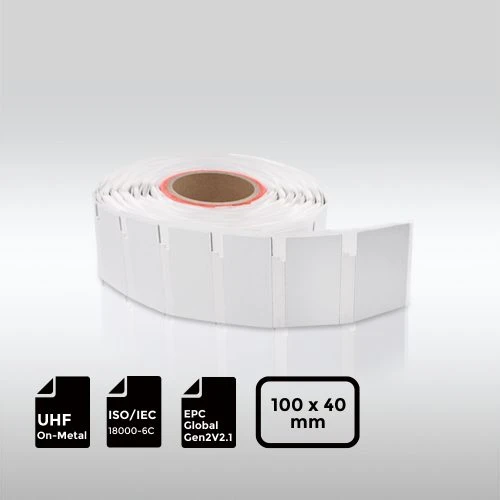
On-Metal & On-Liquid NXP® UCODE® 9xm UHF RFID Label | 100×40 mm

The 100×40 mm NXP® UCODE® 9xm On-Metal & On-Liquid RFID label is engineered for reliable performance on metal surfaces and liquid-filled containers. Featuring a high-performance UHF chip with large user memory,it enables long read ranges,fast inventory of dense tag populations, and supports demanding RFID applications. Constructed from PET,aluminum foil,and foam,the label is durable,tear-resistant, and flexible,with self-adhesive backing for easy application on flat or curved surfaces. It is ideal for asset tracking, electronics, cosmetics, beverages, and industrial components, ensuring seamless integration into RFID-enabled systems.
Powered by the NXP® UCODE® 9xe chip and compliant with ISO/IEC 18000-6C and EPC Global Gen2v2.1 standards, the label delivers high sensitivity, fast inventory speed, and excellent read range. This ensures compatibility with global RFID systems while supporting efficient, scalable tracking across logistics, manufacturing, and warehouse operations.
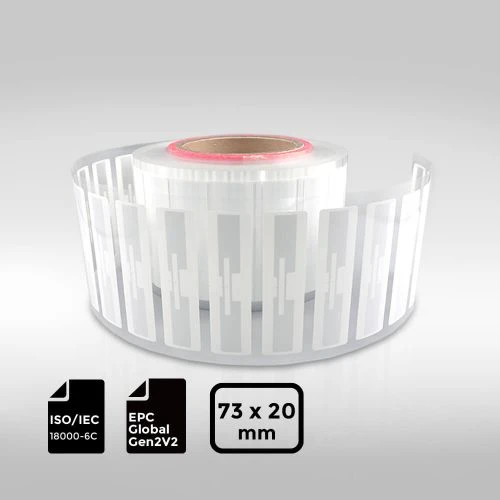
NXP UCODE® 8 PET RFID UHF On-Liquid Label | 73×20mm
The NXP UCODE® 8 PET RFID On-Liquid Label is specifically designed to perform better on glass bottles and is specially engineered for high-performance RFID tagging on liquid-filled containers or moist environments. Powered by the advanced UCODE® 8 chip, it offers exceptional read sensitivity, faster inventory counts, and enhanced data reliability, making it ideal for challenging applications involving liquids.
Constructed with durable PET material, this label provides strong adhesion and resistance to water, chemicals, and abrasion. It performs reliably on curved or irregular surfaces and is perfectly suited for tracking bottled products, cosmetics, chemicals, and pharmaceuticals — improving inventory visibility and operational efficiency.

UCODE® 8 PET RFID On-Liquid Label | 43×18mm
Specifically designed to perform better on glass bottles, UHF UCODE® 8 RFID on-liquid PET labels are a cutting-edge solution designed to provide reliable and accurate tracking in challenging environments where the presence of liquids may interfere with RFID performance. The label uses a durable and flexible PET material that ensures optimal reading range and stability even if applied directly to containers filled with liquid.