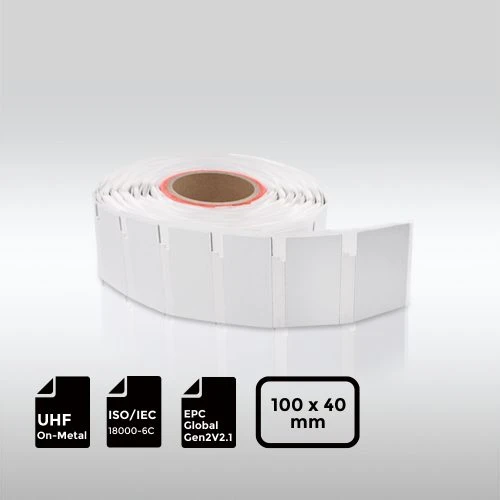
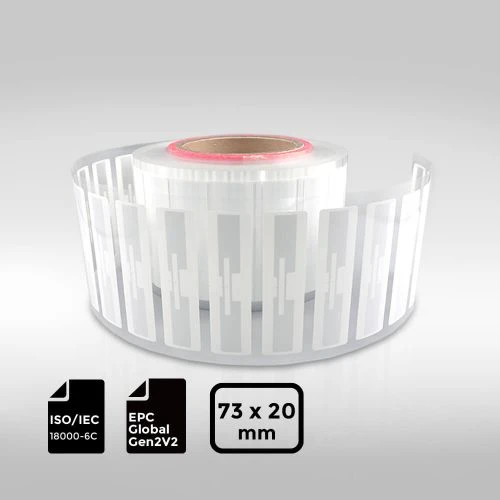
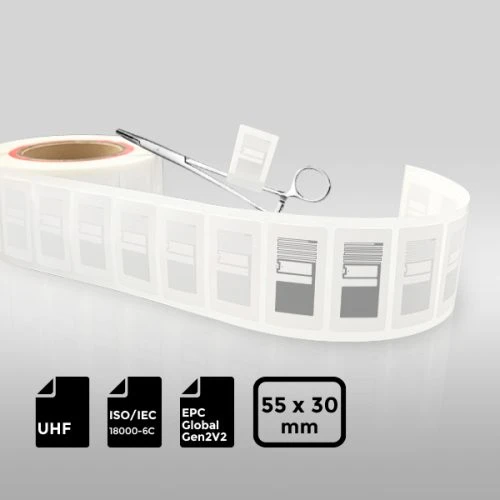
RFID labels for liquid-containing products need to be tested differently from standard RFID labels.
A label that works well on a dry carton, empty bottle, or flat sample may perform very differently after it is attached to a filled bottle, cleaner container, medicine vial, cosmetic bottle, or chemical reagent container. Liquid can absorb and weaken RF energy, and the final read result may change with the liquid type, bottle shape, fill level, label position, reader setup, and carton packing method.
This is why we do not recommend choosing RFID labels for liquid products only by chip model or theoretical read range. For liquid applications, sample testing is part of the selection process.
This article shares practical testing notes for liquid-containing products and explains what to check before using on-liquid RFID labels in warehouse, retail, pharmaceutical, chemical, beverage, and cosmetics projects.
For a complete explanation of how on-liquid RFID labels work and how to choose them, start with our main guide:
→ On-Liquid RFID Labels Complete Guide
Why Liquid Products Need Separate RFID Testing
Liquid products are one of the most common reasons RFID tests change after moving from a sample desk to the real product.
The problem is not always the RFID chip. In many cases, the label was tested in a condition that does not match the actual product.
For example:
- An empty bottle reads better than a filled bottle.
- A single bottle reads better than a full carton.
- A label placed on the upper bottle body reads better than one placed directly against the main liquid volume.
- A label may read well from one angle but fail when the bottle is rotated.
- A warehouse shelf test may perform differently from a handheld reader test.
The reason is that liquid changes the RFID environment. Water-based liquids, detergents, alcohol, medicines, cosmetics, and chemical solutions can all affect RFID signals in different ways.
For this reason, liquid RFID projects should always be tested with real filled products, not only empty packaging or label samples.

What We Usually Check During On-Liquid RFID Label Testing
Before recommending an RFID label for liquid-containing products, we usually need to understand the actual product and reading workflow.
Useful testing information includes:
| Test Item | What to Check | Why It Matters |
| Liquid type | Water-based liquid, alcohol, oil, medicine, cosmetics, detergent, chemical solution | Different liquids absorb RF energy differently |
| Container material | Glass, PET, HDPE, plastic, metalized packaging | Container material affects both signal behavior and adhesion |
| Bottle shape | Flat, curved, small vial, large bottle, irregular surface | Curved or narrow surfaces may change antenna performance |
| Fill level | Empty, half-filled, full | Filled containers may reduce read distance |
| Label position | Bottle body, above liquid line, neck, flag position | Placement can change read stability |
| Reading mode | Handheld reader, fixed reader, conveyor, shelf, carton scan | Different workflows need different read zones |
| Packing condition | Single bottle, full carton, stacked carton, pallet | Bulk packing changes RFID performance |
| Environment | Cold chain, moisture, chemical exposure, transport stress | Affects material, adhesive, and long-term attachment |
| Data requirement | EPC, SKU, batch number, expiration date, serial number | Determines encoding and traceability setup |
This checklist matters because liquid RFID performance is not decided by the label alone. It is decided by the label, product, liquid, placement, reader, and workflow together.
Test Observation 1: Empty Bottle Reading Does Not Equal Full Bottle Reading
One common mistake is testing only empty bottles.
An RFID label may read clearly on an empty glass or plastic bottle. But after the bottle is filled, the result can change. Water-based liquids, medicines, drinks, detergents, and cosmetics may absorb part of the RF energy and reduce the effective read range.
For this reason, testing should include the actual filled product.
If the final product is a beverage bottle, test the beverage bottle.
If the final product is a detergent container, test the filled detergent container.
If the final product is a medicine vial, test the vial with the real liquid or a close test substitute.
A dry package test is useful for early screening, but it should not be treated as final proof.

Test Observation 2: Label Position Can Change the Result
For liquid products, label position can be as important as label model.
A label placed directly against the main liquid volume may experience more signal loss. In some bottle projects, placing the label above the liquid line can improve readability because the antenna is less affected by the liquid inside the container.
This is especially important for:
- Detergent bottles
- Automotive cleaning products
- Beverage bottles
- Medicine bottles
- Cosmetic liquids
- Chemical reagent bottles
- Small vials
- Curved containers
This is the kind of detail that should be tested before mass production.
Test Observation 3: Single-Bottle Tests Are Not Enough
A single-bottle test is a good starting point, but it does not represent a warehouse, retail shelf, or logistics carton.
Once bottles are packed together, the reading environment changes.
Nearby liquid products can absorb more RF energy. Carton orientation can affect how the reader sees each label. Stacked bottles may create different read results from a single bottle standing alone.
For liquid product tracking, we recommend testing at three levels:
- Single bottle test
Check whether the label works on one filled product. - Full carton test
Check whether labels can still be read after products are packed together. - Stacked carton or shelf test
Check whether the RFID system still works in a realistic warehouse or retail condition.
This step is often where early assumptions change.

Test Observation 4: Flag Design May Help in Some Liquid Applications
For some liquid products, a flag-style RFID label can improve readability.
The idea is simple: instead of keeping the antenna flat against the liquid container, the flag structure allows part of the RFID antenna to stand away from the liquid surface. This can create more air space around the antenna and reduce liquid interference.
Flag design is often worth testing when:
- The bottle is small.
- The product contains a high-water liquid.
- The container is curved.
- The label must be read at longer distance.
- Standard flat placement gives unstable results.
- The label cannot be moved above the liquid line.
One of the real test videos we provided compares flag RFID labels versus regular RFID labels used around medical instruments and reagents, which is a useful visual reference for this kind of structure.
However, flag labels are not always the best answer. They may affect packaging appearance, transportation, friction resistance, or automatic labeling. The final decision still depends on the product, packaging, and reading workflow.
Test Observation 5: UHF Can Work, But Stable Reading Matters More Than Theoretical Range
UHF RFID is often selected for liquid product tracking because it supports faster reading and better inventory efficiency than manual scanning or one-by-one barcode checking.
Actual read performance depends on:
- Liquid type
- Bottle size
- Bottle shape
- Label position
- Tag orientation
- Reader power
- Reader antenna angle
- Single bottle or carton condition
- Nearby products and shelves
- Operating environment
A stable read result in the real environment is more valuable than a high number from a simple lab setup.

Test Observation 6: Label Material and Adhesive Also Matter
Liquid product projects are not only about RFID signal performance.
The physical label must also survive the product environment.
In practical testing, we also need to check:
- Does the label stay attached after handling?
- Does condensation affect the adhesive?
- Does the label deform on curved bottles?
- Does the printed information remain readable?
- Does the label survive cold storage, transport, or chemical exposure?
- Does the label still read after the product is packed or stacked?
A label that reads well but peels off is still a failed solution.
Watch Our On-Liquid RFID Label Test Videos
Written specifications are useful, but liquid RFID performance is easier to understand when you see the test setup.
We recommend watching the following real demonstration videos before choosing a label structure or planning sample tests.
1. UHF UCODE 8 RFID On-Liquid PET Label Test on Different Containers

This video tests the reading performance of a UHF UCODE 8 RFID on-liquid PET label on different liquid container surfaces. The search result confirms the video focuses on testing the UHF UCODE 8 RFID on-liquid PET label across different liquid containers.
2. Flag Design vs Normal RFID Labels for Medical Instruments and Reagents

This video compares flag RFID labels with regular RFID labels around medical instruments and reagents, which is useful when evaluating label structure for liquid or reagent-related applications.
3. RFID On-Liquid Label Performance Test

This video focuses on RFID on-liquid label performance testing and compares read distance behavior of normal and on-liquid RFID labels.
4. RFID On-Liquid Labels for Liquid Product Tracking

This video introduces RFID on-liquid labels for liquid product tracking across the supply chain and can be used as a general visual reference for the application.
These videos should not replace your own product test, but they help show why liquid RFID labels need practical validation rather than selection by datasheet alone.
Where RFID Labels for Liquid-Containing Products Are Used
On-liquid RFID labels are commonly tested for products such as:
- Beverage bottles
- Wine and alcohol bottles
- Medicine bottles and vials
- Chemical reagent bottles
- Automotive cleaning products
- Detergent and household liquid containers
- Liquid cosmetics
- Personal care products
- Laboratory samples
- Cold chain liquid products
The business goal may be different in each industry.
For beverages, the focus may be warehouse visibility and carton scanning.
For pharmaceuticals, it may be traceability, batch control, and inventory accuracy.
For chemical products, it may be safety, compliance, and container identification.
For cosmetics, it may be product tracking, smart packaging, and retail inventory.
The label structure should follow the product and workflow, not the other way around.
Common Mistakes in Liquid RFID Label Testing
Testing Only Empty Containers
Empty containers are easier to read than filled containers. Always test the filled product.
Judging by Chip Model Only
The chip matters, but liquid performance also depends on antenna design, label structure, placement, and reader setup.
Ignoring Fill Level
A bottle that is half-filled may behave differently from a full bottle. Test the real fill level used in production.
Testing Only One Bottle
Single-bottle tests do not represent carton, shelf, or pallet conditions. Test the packing format used in operation.
Placing the Label Without Comparing Positions
Small changes in label position can change the result. Test upper body, front label area, neck area, above liquid line, and flag-style placement when possible.
Chasing the Longest Read Range
For liquid products, stable reading in the real workflow is more important than the longest theoretical distance.
Forgetting Adhesive and Material Durability
Liquid products may face moisture, cold storage, friction, transport stress, or chemical exposure. The label must stay attached and readable.

Suggested Testing Checklist for Liquid Products
| Testing Step | What to Do | Why It Matters |
| Test the filled product | Use the real liquid product or close equivalent | Empty packaging may give misleading results |
| Compare label positions | Test bottle body, upper area, neck, above liquid line, and flag position | Placement can change antenna performance |
| Test single and packed products | Compare single bottle, carton, shelf, and stacked condition | Bulk packing changes signal behavior |
| Check reader type | Test handheld, fixed reader, conveyor, or shelf reading | Different systems create different read zones |
| Adjust reader antenna angle | Test more than one reader angle and orientation | Liquid and curved bottles can be direction sensitive |
| Check material durability | Test moisture, cold chain, friction, chemical exposure, and handling | RFID performance is useless if the label fails physically |
| Verify data workflow | Confirm EPC, SKU, batch number, expiration date, or serial number | RFID data must match the traceability system |
| Run a pilot before rollout | Test before mass production | Reduces deployment risk |
Need to Test RFID Labels for Your Liquid Product?
This page focuses on testing observations for liquid-containing products.
For the full technical and selection framework, read the main guide:
→ On-Liquid RFID Labels Complete Guide
For a deeper explanation of why liquid and metal affect RFID performance, read:
→ RFID Material Interference: How Metal and Liquid Affect RFID Performance
If your product contains liquid, do not rely on a standard RFID label without testing.
The right label depends on the liquid type, container material, bottle shape, label position, read distance, packing format, and reader setup.
Share your product type, liquid type, container size, label position, required read range, and reading workflow with our team. We can help recommend suitable RFID labels for liquid-containing products and provide samples for practical testing.
→ Explore On-Liquid RFID Label options
FAQs
1. Can normal RFID labels work on liquid bottles?
Sometimes they can, but the result is often unstable. A normal RFID label may read well on an empty bottle, dry carton, or flat test surface. Once the bottle is filled with water-based liquid, medicine, detergent, cosmetics, alcohol, or chemical solution, the read range may drop sharply. For reliable liquid product tracking, we recommend testing on-liquid RFID labels with the real filled product.
2. Why does liquid affect RFID reading?
Liquid can absorb and weaken RF energy. In UHF RFID applications, the tag needs to receive energy from the reader and send data back through reflected signals. When liquid absorbs part of that energy, the tag may receive less power, respond more weakly, or become unreadable at longer distance. The effect depends on liquid type, bottle shape, fill level, label position, and reader setup.
3. Is an empty bottle test enough?
No. An empty bottle test is useful for early screening, but it does not represent the final product. Filled bottles usually create a different RFID environment, especially when the liquid contains water, alcohol, medicine, detergent, or chemical ingredients. A complete test should include empty bottles, filled bottles, single bottles, full cartons, and realistic shelf or warehouse conditions.
4. Where should RFID labels be placed on liquid bottles?
There is no single best position for every bottle. In many projects, we test several positions, such as the front label area, upper bottle body, above the liquid line, bottle neck, or flag-style position. For some products, placing the label above the main liquid volume can improve readability. The best position should be confirmed through sample testing.
5. What is a flag RFID label and why is it used for liquid products?
A flag RFID label is designed so that part of the RFID antenna stands away from the bottle or container surface. This structure can create more air space around the antenna and reduce liquid interference. It is often worth testing when a normal flat RFID label reads poorly on a liquid bottle, small vial, curved container, or reagent bottle. However, flag labels may affect appearance, packaging, transport, and labeling process, so they should be tested before mass production.
6. Should I test single bottles or full cartons?
Both. A single bottle test helps check the basic label performance. A full carton test shows whether RFID still works when multiple liquid products are packed together. For warehouse or retail applications, stacked cartons, shelves, pallets, or conveyor reading should also be tested. A label that works on one bottle may not perform the same way in bulk packing.
7. What information should I provide before requesting RFID label samples?
Useful information includes product type, liquid type, container material, bottle size, fill level, label position, required read range, reader type, packing method, environment, and data requirements.
If possible, provide photos or samples of the actual container. This helps us recommend a more suitable on-liquid RFID label and reduce testing time.
8. Are on-liquid RFID labels suitable for medicines, cosmetics, beverages, and chemicals?
Yes, but each application needs separate testing. Medicines, cosmetics, beverages, detergents, and chemical products may all contain liquid, but their container shape, liquid composition, storage environment, and traceability requirements are different. The right label should be selected based on the real product and workflow, not only the product category.