


Vehicle identification is no longer just about opening a parking gate.
For parking operators, property managers, toll road operators, logistics parks, campuses, and smart city projects, the real challenge is connecting each physical vehicle to a reliable digital identity.
When vehicle identification is slow or inaccurate, it can create long queues, unauthorized access, payment disputes, toll leakage, poor user experience, and missing vehicle movement records.
RFID technology helps solve this problem by allowing vehicles to be identified automatically through RFID tags, windshield labels, parking stickers, headlight labels, or license plate tags.
This guide gives you a quick overview of how RFID vehicle identification works and helps you choose the right detailed guide based on your application.
What Is RFID Vehicle Identification?
RFID vehicle identification uses radio frequency technology to recognize vehicles automatically.
A typical system includes:
- An RFID vehicle tag or label
- An RFID reader
- An antenna
- Parking, access control, or tolling software
- A barrier gate, payment system, or backend database
The RFID label is usually attached to the windshield, headlight, license plate, side window, or another suitable vehicle surface.
When the vehicle enters the reading zone, the RFID reader captures the tag’s unique ID. The software then checks whether the vehicle is authorized, registered, billable, or restricted.
This makes RFID useful for parking management, gated communities, ETC tolling, fleet gates, logistics yards, and smart traffic systems.

Where Is RFID Used for Vehicles?
RFID vehicle identification can support several different applications. Each one has different requirements for label type, read range, security level, installation position, and system integration.
1. Smart Parking and Parking Management
In parking systems, RFID helps identify registered vehicles automatically at entrances and exits.
It can support:
- Automatic gate opening
- Parking permission control
- Entry and exit records
- Employee or resident parking
- Visitor vehicle management
- Parking payment records
- Reduced manual checking
For parking operators, RFID is not only a faster way to open a gate. It turns each vehicle entry and exit into a digital event that can be recorded, billed, verified, and managed.
Recommended guides:
- The Future of Urban Mobility: Smart Parking Management Systems
- The Ultimate Guide to RFID in Smart Traffic Management and Parking Solutions
2. Vehicle Access Control
RFID is widely used in controlled-access environments where only authorized vehicles should enter.
Common scenarios include:
- Residential communities
- Office parks
- Campuses
- Warehouses
- Logistics parks
- Industrial zones
- Private parking areas
- Restricted facilities
When a registered vehicle approaches the entrance, the RFID system checks the tag ID against the access list. If the vehicle is authorized, the barrier opens automatically. If the tag is invalid, expired, or unknown, the system can deny access or alert security staff.
For this type of project, the RFID label should be selected based on read distance, lane width, vehicle speed, installation position, and whether anti-transfer protection is required.
3. ETC and Electronic Toll Collection
RFID is also widely used in electronic toll collection systems.
In ETC applications, an RFID windshield label or vehicle tag is linked to a vehicle and toll account. When the vehicle passes through the toll lane, the reader captures the tag ID and the system processes the toll record automatically.
Compared with ordinary parking access, ETC systems often require stricter performance:
- Stable outdoor reading
- Faster vehicle recognition
- Durable windshield mounting
- Reliable account matching
- Anti-transfer or anti-fraud protection
- Consistent performance in traffic environments
Recommended guides:

4. Fleet and Logistics Vehicle Management
RFID can also help logistics companies and fleet operators identify vehicles at fixed checkpoints.
It can support:
- Yard entry and exit records
- Loading dock control
- Fleet gate management
- Trailer and container identification
- Route checkpoint verification
- Vehicle dispatch records
- Maintenance and usage records
RFID does not replace GPS for continuous outdoor tracking. Instead, it is better for checkpoint-based vehicle identification.
For example, RFID can confirm that a truck entered a logistics yard, passed a loading area, or exited a controlled gate at a specific time.
5. Security, Anti-Transfer and Toll Evasion Prevention
In paid parking, ETC, and restricted access control, the risk is not only missed reads.
A bigger problem is credential misuse.
If a parking sticker or vehicle tag can be removed and transferred to another car, the system loses trust. This may lead to unauthorized access, toll evasion, parking fee leakage, and identity disputes.
That is why some RFID vehicle labels are designed with tamper-evident or tamper-resistant structures. If the label is removed, the antenna or circuit may be damaged, making reuse difficult.
Recommended guide:

Types of RFID Vehicle Tags and Labels
Different vehicle applications require different RFID tag formats.
RFID Windshield Labels
RFID windshield labels are commonly used for parking access, ETC, and vehicle identification. They are usually attached to the inside or outside of the vehicle windshield.
They are suitable for applications that require stable reading, convenient inspection, and long-range vehicle identification.
Recommended guides:
- What Are RFID Windshield Tags and What Are Their Uses?
- RFID Windshield Label/Tag for Cars
- View RFID Windshield Labels
RFID Parking Stickers
RFID parking stickers are often used to replace paper parking permits, hang tags, or manually checked vehicle passes.
They help parking operators manage vehicle permissions digitally and record vehicle movement automatically.
Recommended guide:
RFID Headlight Labels
RFID headlight labels are often used when the tag needs to be visible, external, and difficult to transfer.
Tamper-evident headlight labels can help prevent the credential from being removed and reused on another vehicle.
They are suitable for smart parking, vehicle access control, tolling, and secure registration projects.
RFID License Plate Tags
RFID license plate tags can help connect a physical vehicle plate with a digital RFID identity.
They are useful for tolling, traffic control, vehicle registration, and anti-evasion applications.
Recommended guide:

RFID Vehicle Label or License Plate Recognition?
Many parking and traffic systems also use license plate recognition cameras.
RFID and license plate recognition are not always competitors. In many projects, they can work together.
| RFID Vehicle Identification | License Plate Recognition |
| Reads a tag ID | Reads a plate image |
| Works as a digital vehicle credential | Works as visual verification |
| Can be linked to access permissions or accounts | Can provide photo evidence |
| Useful for parking, tolling and access control | Useful for audit and enforcement |
| Can use tamper-evident vehicle labels | Depends on plate visibility and camera quality |
RFID is strong for credential-based identification. License plate recognition is strong for visual confirmation. For higher-security systems, using both may provide better reliability.
How to Choose the Right RFID Vehicle Label
Before choosing an RFID vehicle label, consider these questions:
- Where will the label be installed?
Windshield, headlight, license plate, side window, or vehicle body? - What reading distance is required?
A parking gate, ETC lane, logistics yard, and inspection point may all need different read ranges. - Will the vehicle be moving or stopped?
Moving vehicles require more stable tag and reader performance. - Is anti-transfer protection required?
Paid parking, tolling, and restricted access often need tamper-evident labels. - What environment will the label face?
Sunlight, heat, rain, UV exposure, car washing, vibration, and outdoor aging all matter. - What reader and antenna setup will be used?
Tag performance depends heavily on reader power, antenna angle, lane width, mounting height, and vehicle speed. - What security level is needed?
Access control and tolling projects may require stronger identity protection or backend verification.
Explore product options:

Common Mistakes in Vehicle RFID Projects
- Treating the RFID Label as a Small Accessory
The RFID label is the physical identity credential of the vehicle. If the label fails, the software cannot identify the vehicle reliably.
- Testing Only One Vehicle
A system that works for one vehicle may not work in real traffic. Testing should include different vehicles, installation positions, lane positions, speeds, and environmental conditions.
- Ignoring Reader and Antenna Placement
Poor antenna placement can cause missed reads, cross-lane reads, or inconsistent records.
- Choosing a Non-Tamper-Proof Label for Paid Access
If a vehicle credential can be removed and reused, the system may face unauthorized access or revenue leakage.
- Not Planning Software Integration
RFID hardware only captures the tag ID. The real value comes when that ID is connected to parking accounts, toll accounts, access permissions, payment systems, and vehicle records.

Build a More Reliable Vehicle Identification System
RFID vehicle identification is more than a convenient way to open a parking gate.
It helps connect each vehicle with a digital identity that can be used for parking, access control, ETC, fleet management, and smart traffic systems.
The right RFID vehicle label depends on the application, installation position, read range, environment, security needs, and system setup.
If you are planning a parking, tolling, vehicle access, or fleet identification project, start by choosing the right RFID vehicle label and testing it in real conditions.
Explore rfidlabel.com‘s RFID vehicle labels for parking, tolling, access control, and fleet management:

UHF RFID Windshield Label with Security Cuts 110x45mm | Alien Higgs® 9

The Alien Higgs® 9 RFID windshield label is designed to enhance your vehicle tracking capabilities. Embedded with the advanced Alien Higgs® 9 chip, the label compliant to GS1 Class 1 Gen 2 and ISO/IEC 18000-6C to ensure high-accuracy reading. Equipped with a strong and durable 3M467 adhesive, it provides a strong adhesion, perfectly combining security and efficient tracking. In addition, the label adopts a tamper-evident security cuts design, which cannot be used once removed to protect your information security.

Tamper-Proof UHF RFID Headlight Label 99x12mm | ISO18000-6C
The Tamper-Proof UHF RFID Headlight Label offers secure and reliable identification for various applications. Its unique design resists tampering and unauthorized removal, ensuring data integrity. Using UHF RFID technology, it provides long-range reading capabilities for efficient asset tracking. The tag is highly durable, suitable for harsh environments, and features a secure identifier for each item.
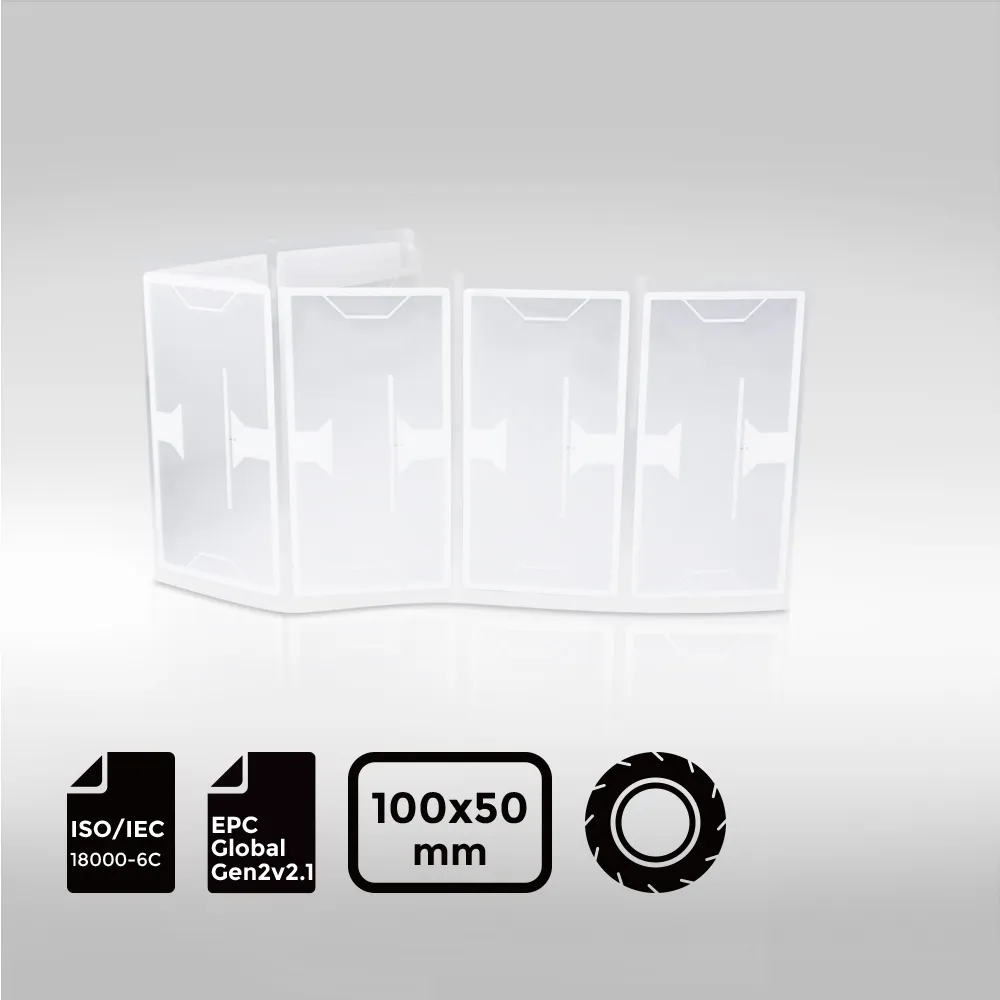
NXP UCODE® 9 PET RFID UHF Tire Label | 100×50mm
The 100×50 mm NXP UCODE® 9 RFID UHF Tire Label is a high-performance RFID label for tire tracking and management. Built with NXP UCODE® 9 chip, this UHF RFID label provides enhanced read range, fast encoding speeds, and excellent reliability in challenging environments.
This RFID tire label is engineered to withstand pressure and exposure to rubber products, making it an ideal solution for tire manufacturing, inventory management, and life-cycle tracking. The 100*50 mm size balances readability and discreet integration into the tire structure. It is designed for embedding or surface application on rubber materials. It is fully compliant with ISO 18000-6C and EPC Class1 Gen2 standards. Each Label has a unique TID and cannot be changed. It is ideal for tire manufacturers, distributors, and fleet management companies seeking an efficient and automated tracking solution.



